
If you’re still asking, “Should we be running ads?” then you’re asking the wrong question.
Here is what we know is happening in B2B today.
Over 70% of buyers define their needs before they ever talk to a sales rep. That means by the time someone fills out your “Request a Quote” form, they’ve already scoped out the landscape, compared solutions, and probably interacted with your competitors.
And they’re doing it online.
In fact, according to our recent study of B2B buyers, 75.5% of industrial buyers begin their purchasing journey on digital platforms. This goes beyond Google and includes LinkedIn, YouTube, and even Instagram. These aren’t just marketing touchpoints anymore. They’re decision-making battlegrounds.
The buyers themselves are changing too. Gen Z and Millennial professionals are now officially the most numerous decision makers for B2B organizations. Boomer and Gen X numbers have dropped dramatically in the last year. The younger crowd doesn’t want to be sold to. Instead, they want to self-educate.
They’re not picking up the phone or replying to cold emails. They are silently vetting vendors long before sales departments ever know they exist.
So let’s reframe the conversation.
The question isn’t whether you should advertise—it’s how and where to do it in a way that actually moves the needle.
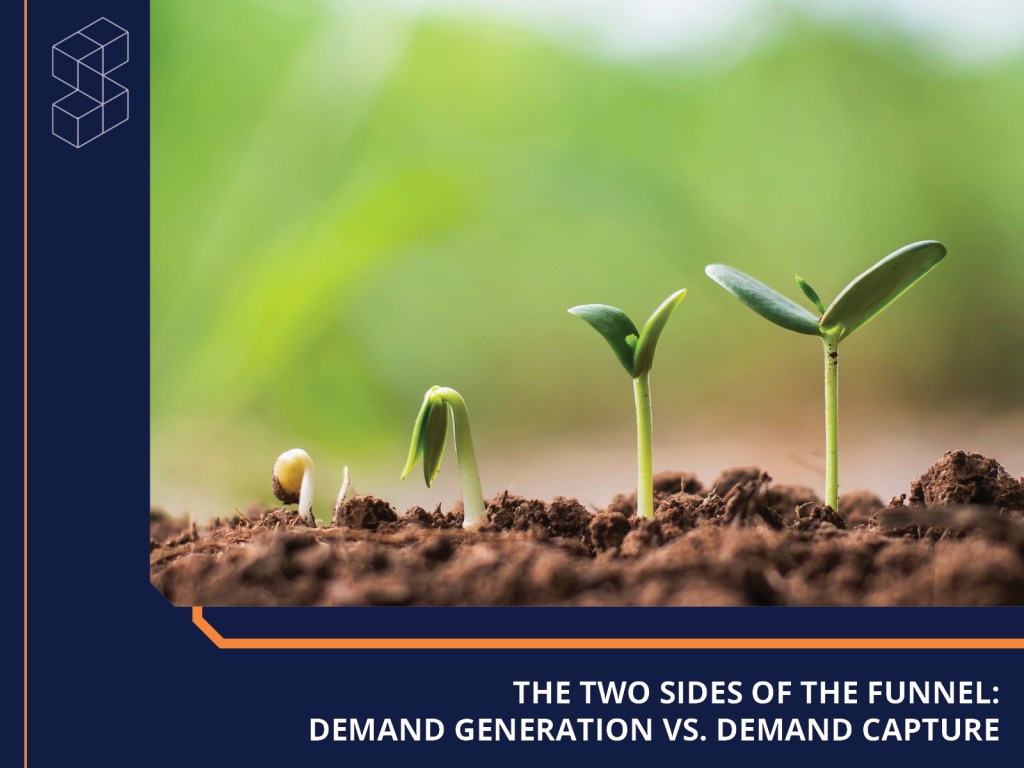
The Two Sides of the Funnel: Demand Generation vs. Demand Capture
To solve how and where you should be advertising, we first need to address the “three percent” problem.
Most B2B companies are fighting over the same small slice of the market: the buyers who are actively looking to make a purchase right now. Nearly every ad dollar is going there, and it’s competitive, expensive, and shortsighted because, in reality, that group of people makes up only 3% of the market.
But what about the other 97%?
These are future buyers who have yet to enter the buying process. If you don’t show up for them, someone else will.
That’s where a two-pronged ad strategy becomes essential: demand generation and demand capture.
Demand Generation: Planting the Seed
Demand generation is the art of creating future demand before a buyer ever submits a form or asks for pricing.
Demand generation is about helping your ideal customer recognize a problem they didn’t fully understand and positioning your brand as the trusted guide toward the solution, not pushing your product. These efforts lay the groundwork for tomorrow’s revenue by building awareness, trust, and authority over time.
Think of it as your company’s introduction to the market. But instead of a sales pitch, you’re showing up with insights, resources, and thought leadership that resonate with your audience’s pain points and priorities.
Consider this scenario: your ideal client is starting to experience the problem you solve. They are researching why something is happening and ways to make their equipment work. They haven’t even considered replacing any equipment or getting the budget to do so, but they will. In the meantime, they are researching. That’s where demand generation comes in.
- What it is: Strategic content and ads that build awareness and interest in the problems your solution solves.
- Who it’s for: Buyers who are not yet in the market, but will be.
- When to use it: When entering new markets or selling complex or high-consideration products, or when positioning is key to long-term growth.
Demand generation campaigns might promote:
- Educational content (such as ebooks, guides, or trend reports),
- Industry insights (such as benchmark data or analyst research), or
- Thought leadership (in the form of videos, webinars, or expert interviews).
These aren’t your typical “demo now” calls to action, and that’s the point. You’re investing in familiarity and trust so that you’re already on the buyer’s radar when they’re ready.
Demand Capture: Reaping the Leads
Demand capture flips the script and turns existing intent into pipeline. Demand capture speaks to the buyers who are already in the market. They know they have a problem, and they’re actively looking for a solution. Your job is to make sure they find you, not your competitor.
This is the part of your strategy that focuses on converting attention into action. Think high-intent search ads, bottom-of-funnel offers, and ad retargeting. Demand capture campaigns are built to intercept and convert prospects who are ready to move, not to educate those who are still researching.
- What it is: Targeting and converting buyers who are already aware of a problem and searching for a solution.
- Who it’s for: Decision makers actively evaluating vendors, pricing, and features.
- When to use it: Driving immediate opportunities, generating qualified leads, and accelerating the sales cycle.
Demand capture tactics often include:
- Google Search Ads targeting high-intent keywords,
- Retargeting campaigns aimed at site visitors or previous engagers, or
- Offers like demos, case studies, or pricing guides.
Here, relevance and timing are everything. Your offer needs to match what the buyer is thinking about right now. That’s why demand capture works best when your messaging, targeting, and landing experience are all tightly aligned.
Demand capture and demand generation work in tandem. Demand generation can build your pipeline and establish trust, so when a lead shifts into buying mode, your demand capture strategy can easily pull them in. By then, they know who you are, what you offer, and why they should choose you. While they might have to get other quotes, you have an advantage.
Demand generation builds brand equity. Demand capture converts that equity into pipeline. You can’t afford to do one without the other.
Where to Run Your Ads: The Best Platforms for B2B
Not all platforms—or ad types—are created equal, especially in the world of industrial B2B marketing. Choosing the right mix comes down to understanding buyer intent and matching the platform to the stage of the funnel you’re targeting.
Google Ads
With regard to capturing intent in B2B, few platforms rival the precision and immediacy of Google Ads. It’s the first stop for most high-intent buyers—especially in industrial sectors—because when someone’s typing “predictive maintenance tools” or “buy industrial conveyor belts” into Google, they’re already in solution mode. That’s demand capture in action.
Search ads are particularly powerful here. They connect you with buyers who are actively seeking what you offer, often in the final stages of their decision process. They can be highly impactful with a relatively small budget. But success isn’t just about showing up. It’s about alignment. That means your ad copy, your landing page, and your offer all need to match the intent behind the keyword. A page optimized for “asset-monitoring software” shouldn’t be selling your full industrial IoT platform. Rather, it should relate to exactly what the user searched for. The tighter the alignment, the higher the conversion rate.
This is where keyword research becomes critical. Unlike social platforms where you target based on roles or interests, Google’s power lies in the search terms your prospects are using. For search campaigns, your search terms are your targeting. While you can narrow down your audience by geography and language, the search terms largely define your audience.
Just like any marketplace, there’s an economic model behind it. As outlined in one of our favorite books by our CEO (grab your free e-copy at the end of the blog post), the auction price for a keyword—the point where supply and demand meet—is driven by how valuable and competitive that term is. High-intent keywords like “buy industrial conveyor belts” command premium prices because they’re closer to revenue. On the other hand, keywords like “how to evaluate conveyor belts,” which sit earlier in the funnel, cost less and attract more clicks but typically convert at a lower rate. Both have their place. The key is knowing when to use each: high-intent terms for pipeline now and informational terms for nurturing tomorrow’s buyers.

Beyond search, Google Display Network also plays a role, just not in the same way. Display ads are designed not for conversion, but instead for remarketing. Once a prospect has visited or engaged with your content, display ads let you show up again on other platforms, such as industry news sites, blogs, or YouTube. It’s lightweight visibility, and it works. Just don’t expect it to fill out your CRM.
In short, Google Ads are your frontline tool for converting search intent into leads—but only if your strategy respects the economics of attention, aligns your messaging with buyer behavior, and plays both the short and long game.
LinkedIn Ads
When it comes to B2B demand generation, LinkedIn Ads are the gold standard. This is the platform built for professionals and, more importantly, for precision. Unlike Google, where intent is inferred from search terms, LinkedIn lets you go straight to the source: job titles, industries, company size, seniority, and even specific companies.
You’re not guessing who your audience is—you’re choosing it.
That makes LinkedIn the best option for building awareness and credibility at the top and middle of the funnel. While buyers are not necessarily searching for solutions on LinkedIn, they are there to stay informed, connected, and engaged with industry content.
Use LinkedIn Ads to deliver thought leadership that positions your company as the expert. Promote webinars, ebooks, whitepapers, and benchmark reports. Think of the kind of content that sparks interest and builds trust before a buyer ever lands on your pricing page. This is demand generation in action: you’re not asking for the sale; you’re earning attention.
It’s also where visual storytelling matters. Your ad creative should reinforce your brand identity while clearly communicating value. Clean design, strong headlines, and concise messaging go a long way.
Costs per click (CPCs) on LinkedIn tend to run higher than on other platforms, but the targeting makes up for it. You’re paying for relevance. In B2B, that’s exactly where your dollars should go.
So if you’re serious about building awareness among the right decision makers in the right industries, LinkedIn should be a priority.
Meta Ads
While Meta (Facebook and Instagram) may not be the first platform that comes to mind for B2B advertising, it still plays a valuable supporting role, especially when you understand how to use it.
No, the targeting isn’t as precise as on LinkedIn. You won’t be drilling down into job titles or seniority levels. But you can access your audience in moments that other platforms can’t touch. These are the evenings, weekends, and lunch breaks where your buyers are scrolling, consuming, and open to being influenced.
That makes Meta a powerful channel for remarketing, lightweight brand awareness, and content amplification. If someone visited your site but didn’t convert, Meta lets you follow up with visuals and messaging that keep your brand top of mind. If you’ve published a strong piece of content— a video, a customer story, a stat-packed guide—Meta can help extend its reach beyond your usual email list or LinkedIn feed.
Meta is about presence. You’re reminding prospects who you are, reinforcing your value, and subtly building credibility. As a bonus, the cost per impression is often far lower than on LinkedIn, making it an efficient way to support your full-funnel strategy.
In short, Meta might not be your core demand engine, but it’s a smart way to stay visible, relevant, and connected to buyers in the moments between intent.

What Makes a Great B2B Ad?
There’s no magical solution when it comes to B2B advertising, but there are common threads in the ads that consistently perform well across industries and platforms. Our most effective ads all share five key traits.
1. Clear, Value-Driven Messaging
In B2B, clarity wins. Your buyers don’t have time to decode vague promises or sift through buzzwords. Speak directly to the pain point, and make it obvious what’s in it for them. Specificity builds trust, especially when you can tie your solution to outcomes.
Think less “Innovative Industrial Solutions” and more “Cut downtime by 30% with predictive maintenance you can trust.”
That’s the kind of message that stops a scroll and starts a conversation.
2. Strong Creative
Your creative doesn’t need to be flashy, but it does need to be relevant. The best-performing ads use clean visuals that match the brand, convey the value quickly, and often include motion or data visualization. Especially on LinkedIn, charts, graphs, or short videos showing results tend to outperform text or static visuals alone.
If you’re stuck creatively, here’s a simple pro tip: Check out Meta’s Ad Library. It’s a goldmine of competitive inspiration and a smart way to see what others in your space are testing and scaling.
3. A Relevant Offer
Not everyone is ready to book a demo, and that’s okay. Great ads meet buyers where they are in their journey and offer something they actually want.
Here’s a quick funnel-aligned framework:
- TOF (Top of Funnel): ebooks, industry reports, educational guides
- MOF (Middle of Funnel): case studies, webinars, checklists
- BOF (Bottom of Funnel): demo requests, pricing guides, comparison tools, user-generated content
4. Smart Targeting and Segmentation
One of the biggest mistakes in B2B ads is going too broad. Great ads speak to a specific person, in a specific role, dealing with a specific challenge. That’s where segmentation comes in.
Tailor your messaging by industry, job function, and stage in the buyer journey. A plant manager in food processing is not the same as a procurement lead in aerospace. The more personal and precise you are, the more likely you are to drive engagement. While your message is important here, your targeting is just as important. If you aren’t using your targeting tools correctly, you’re wasting dollars showing ads to the wrong people.
Keep in mind that we usually see the 80/20 rule heavily at play in ads. That means 20% of your targeting assets (keywords, interests, etc., depending on your platform) will make up 80% of your traffic. When you first start campaigns, pay close attention to which targeting assets are working harder for you than others.
5. A Clear Campaign Goal
Every ad should be working toward a measurable outcome. Sometimes that’s a direct increase in pipeline flow. Other times it’s brand awareness, content downloads, or event registrations. The key is to define the goal early and then ensure that your ad design, funnel, and offer all support it.
If you’re not clear on the goal, your audience won’t be either. That’s when clicks get wasted and conversions stall.
Remember: Ads are all about testing.
Your audience and all your assets could be in place, yet the ad is underperforming. In that case, you might just need a simple headline tweak. In other cases, a well-performing ad might start to decline suddenly. This could be due to ad frequency: as the ad succeeds, the platform shows it more. People can get tired of it, which can have a sudden impact on the ad’s performance. The simple solution is to tweak the copy and creative. The more complex solution is to switch up your audience.
Ads That Work Together Work Best
If there’s one thing to take away from this, it’s this: successful B2B advertising isn’t about choosing between demand generation or demand capture. It’s about integrating both.
You need to create awareness before you can capture intent. Once that intent is present, your brand should be the obvious choice.
The most effective strategies don’t treat the funnel as a series of disconnected steps. They build seamless, intentional customer journeys. That means tracking beyond last-click attribution, understanding the true influence of every ad, and building campaigns that nurture and convert across the full buyer lifecycle.
The best B2B advertisers know how to play the long game. But they also know when to ask for the sale.
If you’re ready to go deeper into building a full-funnel ad strategy that’s actually built for industrial buyers, download our CEO Nate Maguire’s new book: The Blueprint for Industrial Marketing. It covers real-world ad formulas, platform strategies, and how to match your ad approach to your business goals.
Download the book for free now and start turning your ads into real business outcomes.