

Industrial buyers are doing their homework, and they’re doing it on their own. According to our research, 75.5 percent start their supplier search online, and two-thirds rate online information as critically important in the decision process.
That shift has big implications. It means your buyer is forming opinions long before they talk to sales. It also means traditional outreach—cold calls, trade show lists, generic follow-ups—is no longer enough.
Yet nearly half of B2B companies say generating enough leads is still one of their biggest challenges. That’s not surprising. Sales cycles are getting longer, competition is growing, and most marketing content still feels like noise.
This is where lead magnets come in. Done right, they meet the buyer at a moment of curiosity and turn that curiosity into a conversation. They bridge the gap between interest and intent by being helpful first.
But not all lead magnets stand out. You have mere seconds to grab the reader’s attention, so standing out from the crowd is the key to success.

What Is a B2B Lead Magnet?
A lead magnet is a resource that solves a specific problem for your ideal buyer in exchange for their contact information. It’s the first step in a value-based conversation.
This matters because today’s industrial buyers don’t want to be sold to. They want answers and clarity. A lead magnet gives them both while earning you permission to follow up.
In B2B, especially in technical markets, lead magnets help build trust before a sales conversation ever happens. They turn anonymous visitors into engaged prospects by addressing a pain point head-on.
Lead magnets support both inbound and account-based marketing (ABM) campaigns. In inbound funnels, they attract and qualify leads organically. In ABM campaigns, they act as strategic entry points for targeted outreach.
So what do lead magnets actually look like?
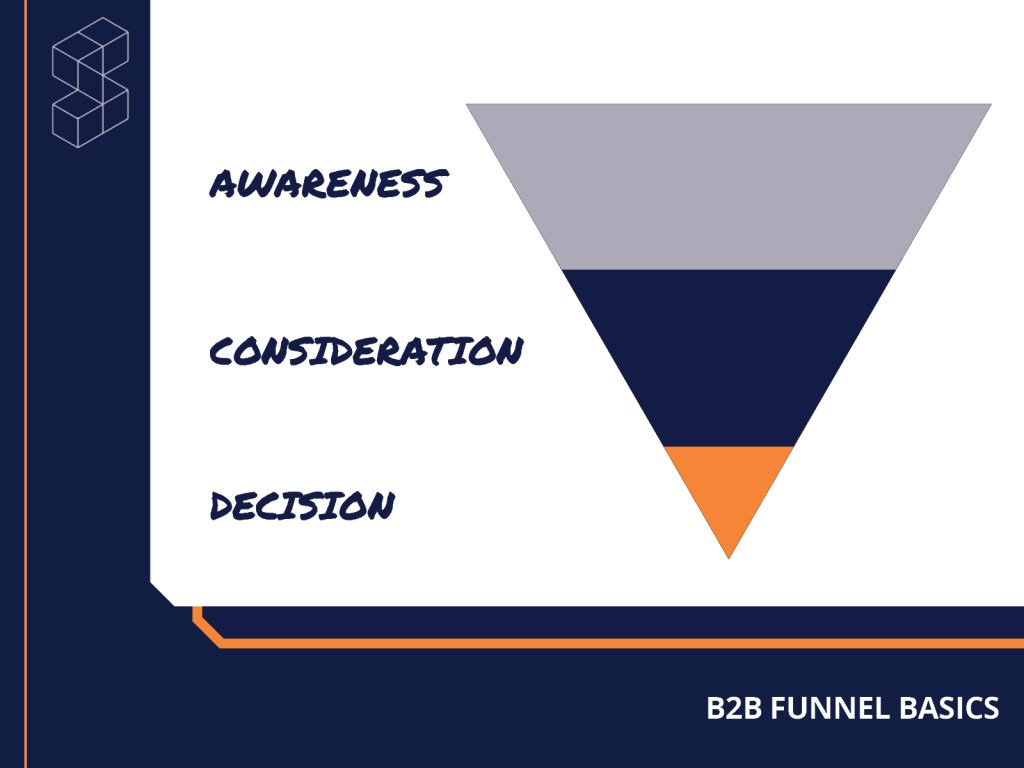
B2B Funnel Basics
Every B2B marketing funnel has three main stages: top, middle, and bottom of the funnel. Each stage corresponds to where a buyer is in their decision-making process and what kind of content they need to move forward.
Top of funnel is where awareness develops. At this stage, your audience is just starting to learn about their problem. They are not ready to evaluate vendors. They are trying to understand the issue and identify possible solutions. Your job here is to educate, not to pitch.
Middle of funnel is where consideration begins. Buyers know the problem and are actively looking at ways to solve it. They are comparing approaches, weighing priorities, and starting to form opinions about which companies might help. This is where you show your expertise and build trust.
Bottom of funnel is where decisions are made. These buyers are closer to action. They are narrowing options, getting buy-in from others, and looking for confidence in their next step. Your content should reduce risk, answer final objections, and make it easy to say yes.
The right lead magnet aligns with each of these stages. That is what makes it effective.
When your content matches buyer intent, you move leads through the funnel with less resistance. In other words, you get higher-quality leads.

Standard Lead Magnets
There are a few lead magnets we see often in B2B marketing. They are familiar, widely used, and can still work when done well. But most companies treat them as a checklist instead of as a strategy.
Ebooks
Ebooks are one of the most common lead magnets in B2B marketing. Most industrial companies have at least one. They tend to cover broad topics and are often used at the top of the funnel to attract early interest.
The problem is not the format. It is the lack of focus. Many ebooks are too long, too short, too generic, or built without a clear next step for the reader.
Strativise still recommends ebooks in the right context. In fact, we still use one or two ourselves. A well-structured ebook that solves a specific problem or shares original research can still deliver strong results. The key is to make it useful and focused. Avoid the temptation to make it a digital brochure.
If you are going to invest in an ebook, make sure it answers one clear question and points the reader to a natural next step.
Webinars
Webinars are another go-to lead magnet in B2B. They offer a chance to teach, demo, or discuss. With the added benefit of live interaction, there’s a lot of room to build relationships here.
But most webinars miss the mark. They try to cover too much, go on too long, or feel like thinly veiled sales pitches. That creates drop-off and damages trust.
The best webinars are focused and practical. They solve one specific problem for a targeted audience and deliver clear takeaways. When paired with thoughtful follow-up, they can build strong mid-funnel momentum.
We have seen webinars work very well for some of our clients, but, by and large, they are poorly utilized. They should be an integral part of a complex funnel. Instead, people often just throw up a few LinkedIn posts and a banner on their website and call it a day.
What this means, though, is that webinars are time-consuming. Not only do you need to take the time to properly build the webinar so that it delivers all the value you promise, but you also need to build the surrounding funnel. We also recommend running ads for the webinar, which is another added expense on top of the webinar-hosting equipment.
So if you’re going to do webinars, you need to be ready to make the investment to make them worthwhile.
Guides and Checklists
Guides and checklists are simple, practical tools that work well throughout the funnel. They are easy to consume, easy to share, and immediately useful. And, unlike webinars, they are easy to create.
In technical industries, these tools can simplify complex decisions—such as preparing for a facility upgrade, evaluating new equipment, or comparing systems. That makes them a strong fit for both top- and middle-of-funnel content.
We recommend them when you want to be helpful without asking for too much. A good checklist builds confidence and removes friction, which is exactly what your buyer needs before they talk to sales.
Focus on one job the buyer is trying to do. Make it clear, scannable, and outcome-driven.
Whitepapers
Whitepapers still have a place in B2B marketing, especially when you are speaking to technical buyers. These readers want depth and proof. A good whitepaper offers both.
They work best when the stakes are high and the decision is complex. Think capital investments, regulatory compliance, or multi-year contracts. In these cases, buyers want to validate that your team knows what it’s doing and why your approach is best.
Strativise’s research confirms this. Over 80 percent of industrial buyers look for product and technical information when evaluating suppliers, and more than 70 percent want company-specific facts. That’s exactly the kind of content a well-built whitepaper delivers.
But there is a catch. Whitepapers only work when the content is worth the read. Too many get stuffed with buzzwords or recycled blog posts. If you are going to ask someone to spend ten or fifteen minutes with your content, you need to earn that time.
We also recommend thinking carefully about distribution. Whitepapers rarely generate results on their own. They need to be part of a larger content strategy that includes repurposing key points into shorter formats, using them in sales follow-ups, and pairing them with ad retargeting.
If your buyers are deeply technical and your solution is complex, a strong whitepaper can be the credibility boost that tips the scale.
Do These B2B Lead Magnets Work?
These lead magnets can work, but only in specific circumstances and with certain audiences.
Most industrial companies use lead magnets even if they do not call them by that name. They often have several different ones. That is not the problem. The issue is that too many are built without a clear strategy. They are checked boxes, not intentionally used tools.
Used the right way, these formats can support every stage of the funnel. But that requires focus. You need to match the right format to the right audience at the right time.
This also means there is opportunity. Most companies are not doing this well. That creates a gap and a chance to stand out. With just a little more relevance, clarity, and polish, your lead magnets can immediately feel different from what buyers are used to seeing. You could do this with traditional lead magnets, or you could start by thinking outside the box.
Ask yourself this: when you see another webinar or ebook promoted online, do you stop what you are doing to sign up? Probably not, unless it speaks directly to a challenge you are actively trying to solve.

Creative B2B Lead Magnets
Creative lead magnets are strategic tools that stand out by delivering value in unexpected ways. They offer new formats, fresh angles, and a stronger connection to what your buyer actually needs.
They also give you a chance to meet buyers where they are with tools that help them solve problems faster, get answers on their own, or take the next step with more confidence.
A. Interactive Tools
Buyers are calculating, comparing, and exploring, not just reading. That is where interactive tools come in.
Think ROI calculators, cost-of-delay estimators, spec-comparison widgets. These tools work because they meet the buyer when they’re deep in the problem, trying to make sense of the options.
These tools offer what everyone is looking for—clarity—without threatening to trap them in a sales call. Interactive tools help your buyer do the math, map the risk, or validate a choice before they ever talk to your team. That kind of self-serve value goes a long way in building trust.
And here is the good news: you don’t need to over-engineer it. A clean Excel calculator or a simple Which solution is right for me? selector can do the job. It just needs to answer a real question that your buyer is already asking.
You just need to make the next step easier. That is what earns attention in a crowded market.
B. Original Research / Industry Reports
Original research positions your company as a source of insight and information. It shifts the dynamic from vendor to thought partner.
This kind of lead magnet works because buyers want to see what others are thinking. What trends are emerging? Where are peers investing? What are they worried about that I’m not?
A well-crafted industry report gives your audience a reason to engage that goes beyond your product. And when the data is tied to a real problem your team solves, it creates a natural bridge to deeper conversations.
This is also one of the best formats for outbound marketing. Sending a report feels helpful, and following up on it feels natural.
If you are publishing something like this, treat it like a flagship asset. It needs a full campaign with ads, a landing page, a deliverable, follow-up emails, and a full back-end management system. Combined with the process of developing a thoughtful and illuminating questionnaire, this is a big project but is well worth it. You might do this type of lead magnet once every year or two, whereas others would be simple to produce once a quarter. But this is a resource you can leverage for a very long time.
C. Email Series and Micro-Courses
Sometimes the best lead magnet is a conversation stretched out over time.
Email series and micro-courses offer a low-friction way to stay in your buyer’s world. Instead of asking them to read a twelve-page PDF today, you offer small, useful insights over the next few weeks. It keeps your brand top of mind while building trust at a steady pace.
These work well with a topic that benefits from repetition or sequencing, such as maintenance tips, process optimization, or change management. You are helping the buyer get smarter in small doses, and each message reinforces the last.
We recommend keeping these short and focused: one idea per email with a clear takeaway.
They also stack well with outbound campaigns. Offering a micro-course feels helpful, and following up on how it’s going feels natural. It moves the relationship forward without forcing a decision.
If your goal is long-term engagement, this format is a strong play.
D. Templates and Configurators
Templates and configurators give your buyer a head start by simplifying planning, reducing errors, and making a complex process feel manageable.
This format works because it helps the reader take their first step. You could use a quote builder, a project-kickstart template, or a job site checklist. Whichever way you go, you are eliminating a difficult step from their job.
These lead magnets are especially effective when your solution involves multiple variables or steps. A configurator helps someone map out what they need. A checklist helps them avoid missing something important. These tools feel helpful because they are.
They also create natural points for follow-up. When a buyer downloads a template, your team can check in with a value-add: “Need help filling this out?” or “Want to see how others in your industry use it?”
The key is practicality. Make sure it’s something your buyer would actually use.
E. “Book Bundle” or Premium Giveaways
Sometimes the best lead magnet is something your buyer can hold in their hands.
Sending a printed book or guide changes the tone of the relationship. It tells the buyer: “This matters. We thought this through.” That makes it feel personal instead of promotional.
We’ve seen this work really well in ABM campaigns and post-webinar follow-ups. It gives your team a reason to reach out again, and it sticks in a way that another email never will.
But this only works when the resource is worth the shelf space. Pair the book with a helpful worksheet or checklist. Include a quick note. And remember: the goal is always to move the conversation forward.

How to Choose the Right B2B Lead Magnet
The right lead magnet does one thing really well: it makes the next step easier for your buyer.
That means it has to match where they are in the process. That is not always where you want them to be. Start by asking three simple questions:
- Who is this for?
- What problem are they trying to solve?
- What would help them make progress right now?
A good lead magnet removes friction, and a great one builds trust at the same time. You just need to find the format that fits your audience and gives them a reason to keep engaging.
You can do this by building yourself a marketing engine that works for you over time. If you want to get the exact strategies that we implement with our clients, download a free copy of The Blueprint for Industrial Marketing—a practical guide for B2B teams that need real results, not more theory.