

If you market only to the 3% of buyers ready to purchase today, you’re missing a significant opportunity.
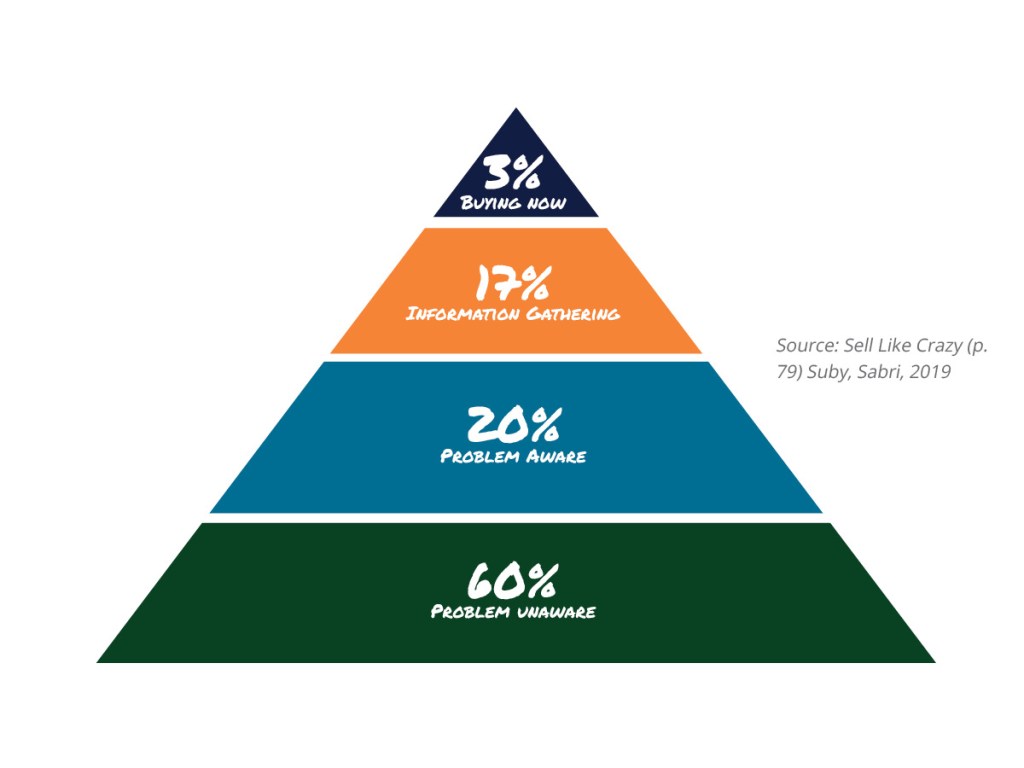
According to Sabri Suby in Sell Like Crazy, only 3% of your audience is in active buying mode. The rest are either researching, exploring their options, or completely unaware that they even have a problem to solve. This means the vast majority of your future customers are being overlooked simply because your marketing isn’t designed to meet them where they are in their journey.
To counter this, you can shift your approach. I’ll break down the 3% trap, how it limits your growth, and what it takes to build a system that attracts, nurtures, and converts buyers across the entire journey. Because if you want to grow in today’s market, you can’t just market to the few who are ready to buy—you’ve got to reach the many who will be buying soon. This is your chance to influence them before their project is out to bid.
Let’s dive in.
Understanding the 3% Trap
Let’s unpack this.
The Larger Market Formula breaks your total market into four key segments:
- 3% are ready to buy right now.
- 17% are actively researching solutions.
- 20% know they have a problem but aren’t looking for a solution yet.
- 60% don’t even know they have a problem.
Most industrial companies spend the majority of their marketing budget chasing the top 3%. On the surface, that makes sense. It is where the “sure thing” feels like it lives and provides immediate ROI. These buyers are sales-ready.
But here’s the catch: everyone is targeting them. Your competitors are saying the same things, offering similar products, and pushing for the same meetings. It’s crowded, expensive, and hard to stand out.
Worse, it’s shortsighted. While you’re fighting over the 3%, you’re ignoring the 97%—the prospects who will become buyers in the coming weeks, months, or quarters. Consider the engineers quietly researching new solutions, procurement managers scrolling LinkedIn, and operations leaders asking questions on forums. If you’re not showing up in these types of places, you’re already out of the conversation.
The 3% trap is the illusion that marketing only matters when someone’s ready to buy. In reality, the companies that win are the ones who build trust long before a purchase ever happens.

What the 97% Really Want
Most industrial companies assume that if someone isn’t ready to buy today, they’re not worth spending marketing dollars on. That couldn’t be further from the truth.
The 97% of buyers who aren’t actively purchasing aren’t uninterested. They’re just not ready to engage with a salesperson yet. But they are trying to answer one core question:
“Can you solve my problem?”
That’s it. That’s what they want to know.
They don’t need a product catalog or a cold call. They need confidence that you understand their application, that you’ve worked in their industry, and that you’ve helped solve similar challenges for companies like theirs. And they want to get that confidence before they talk to anyone from your sales team.
According to Gartner, buyers spend just 17% of their total purchase journey with potential suppliers. When they’re evaluating multiple vendors, your sales team might only get 5% of their time. That means 80–90% of the buyer’s journey is without you in the room.
So where are they spending their time? Researching, comparing, reading case studies, watching videos, asking peers for input, and checking out your LinkedIn content. When they do engage, they’ve already got a shortlist and a solid idea of what they’re looking for.
In that environment, trust is built not in a sales presentation but in your marketing.
If your content doesn’t help buyers see that you understand their world and can solve their problems, they’ll keep looking.

How to Market to Maximize Your Marketing Budget
If you want to grow beyond chasing short-term wins, your marketing needs to engage buyers at every stage of the journey beyond when they are ready to buy. That means rethinking your strategy to meet people earlier, earn their trust, and guide them forward.
Here’s how you do it:
1. Lead With Value, Not a Pitch
The fastest way to lose the 97% is to hit them with a sales message before they’re ready. These buyers are still figuring out what they need. Instead of pushing products or making a strong CTA (call to action) like “request a quote” or “talk to a salesperson,” create content that helps them diagnose problems, understand their options, and avoid common mistakes.
Think blog posts that answer real technical questions, how-to guides, short explainer videos, or tools like ROI calculators and checklists. You’re doing it right if it helps them get smarter or make a better decision.
2. Capture Early Interest With Gated Resources
Buyers want to stay in control, but they’re willing to trade their contact info for something that truly helps them. A strong gated resource—like a technical guide, selection tool, or white paper—gives them value now and gives you a chance to stay in touch.
That gated resource, however, is just the beginning. To turn interest into opportunity, you need a system behind it: automated emails that provide helpful follow-ups, retargeting ads that reinforce your message, and a CRM that alerts you when they’re actively engaging.
3. Segment and Track Buyer Intent
Not all leads are created equal. Some are just beginning to explore. Others are closer to making a decision. Use your CRM and marketing automation to track behaviors (such as content downloads, page views, and email opens) and segment your audience accordingly.
The goal is to nurture early-stage buyers until they raise their hand. That way, your sales team spends time only with the right people at the right moment.
4. Build a Full-Funnel Content Strategy
You need content for every funnel stage:
- Top of Funnel (TOF): Blog posts, educational videos, social content
- Middle of Funnel (MOF): Case studies, technical guides, webinars
- Bottom of Funnel (BOF): Product demos, ROI calculators, buyer’s guides
This is how you stop chasing leads and create a system that brings the right buyers to you.

What Happens When You Get This Right
When you stop chasing just the 3% and start engaging the entire market, something powerful happens: your marketing starts working for you, even when your team isn’t.
We call it the multiplier effect.
Early wins create momentum. The company that builds marketing capability first collects more data, iterates faster, and wins more often. Each campaign teaches you something new about your audience. Each piece of content builds credibility. And over time, the gap between you and your competitors grows wider because you’re learning faster than they are.
Let me give you a great example from one of our clients, a sealing manufacturer.
They saw a consistent market problem: engineers and buyers were making sealing decisions without deep sealing expertise. Their decisions were often based on budget or availability instead of application fit, leading to unnecessary seal failures, downtime, and frustration on all sides.
The issue wasn’t a lack of information—plenty was out there. The problem was that most of it was too technical and hard to digest, especially for engineers who didn’t specialize in sealing.
That’s where we came in.
Strativise worked with our client to create a practical, plain-language resource designed specifically for procurement staff who weren’t sealing experts. It simplified the decision-making process, helped them avoid common mistakes, and positioned our client as a partner who understood engineers’ real-world challenges.
The impact?
- The guide attracted high-quality leads from early in the buying process.
- It gave our client a reason to follow up with value, not just a product pitch.
- It built trust with buyers before they were ready to engage with sales.
That’s what happens when you market to the full buyer journey. You create momentum, educate your market, and stop relying on chance meetings or last-minute RFQs to fill your pipeline.
Stop Wasting Your Marketing Budget
Real growth happens when you start showing up earlier for your ideals. You have to educate, build trust, and become the clear choice before your competitors even know there’s a deal on the table.
You don’t have to do more; just do it smarter. Build a system that works for your business, your team, and your customers. One that attracts the right buyers, moves them through the funnel, and creates momentum that compounds over time.
At Strativise, we help industrial companies build exactly that kind of system. I recently put our top strategies for modern B2B marketing into my new ebook, The Blueprint for Industrial Marketing. It’s the full playbook behind everything we’ve covered here and so much more.
It is now available for download, so you can get started building something better.